
For farmer support programmes
Development programmes fail on execution, not on intent.
Well-designed schemes aimed at food security and inclusion come apart in the same place every time: the inputs do not reach the right place at the right moment, the mentorship is inconsistent, and the reporting is reassembled by hand at the end from records that were never structured to begin with. Then the funder asks what changed, and nobody can answer with evidence.
What we bring
One operational standard across every participant
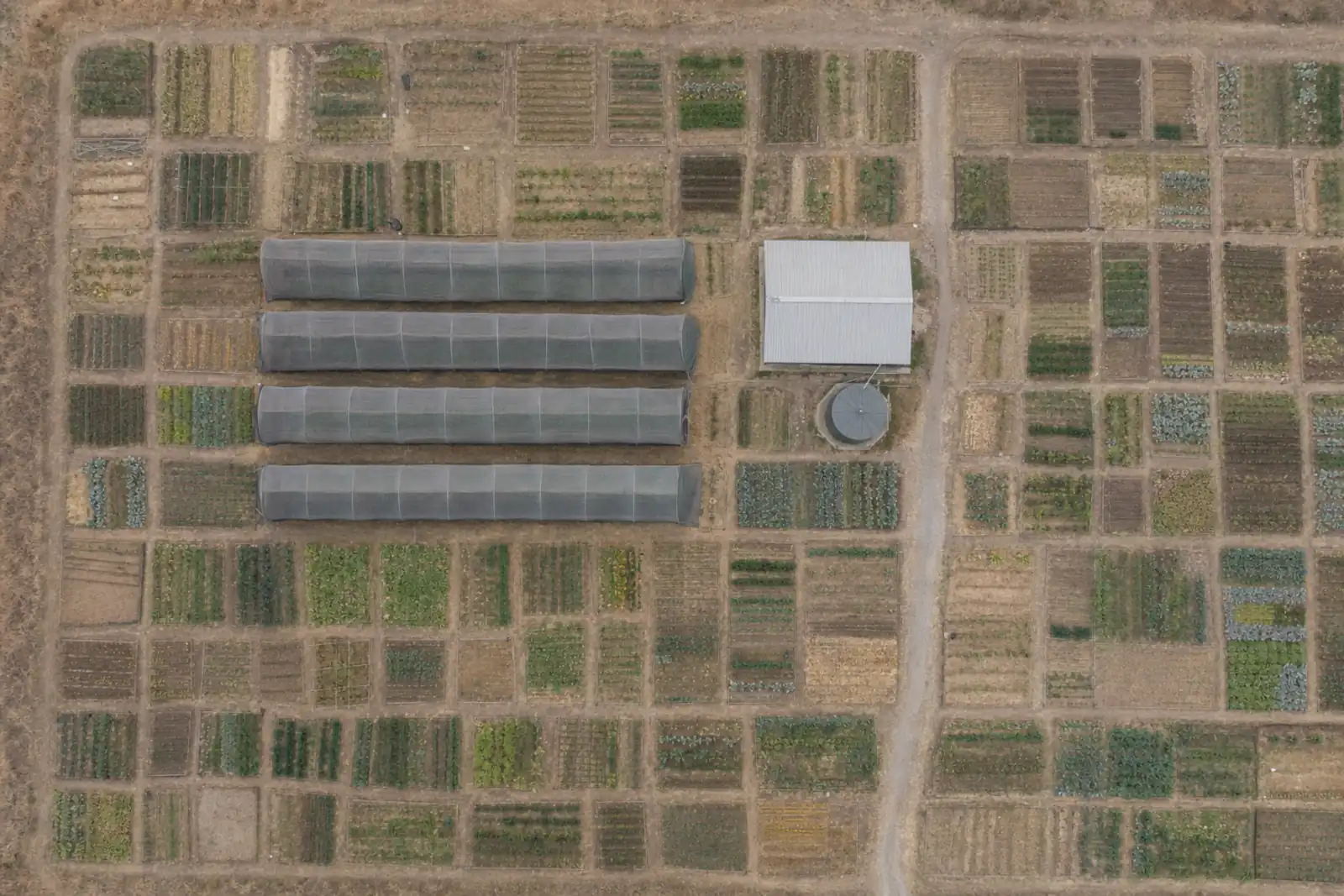
We run commercial farms and development enterprises on the same platform, to the same standard. That is the whole point of the aggregator model: a grower on a few hundred hectares gets the planning discipline, the mechanisation access and the market linkage that would otherwise only be available at commercial scale.
The programme office gets something it has almost never had — a single live view of every enterprise, built from the work as it happens rather than from a survey conducted afterwards.
- Every participant profiled the same way. GPS boundaries, soil and terrain, multi-season productivity zoning, infrastructure and equipment — so participants are comparable to each other and to a commercial benchmark.
- Crop programmes designed, not assumed. Agronomist-built programmes per enterprise, costed per hectare, with cultivar and layout matched to what that specific land can carry.
- Inputs delivered, not disbursed. Procurement runs off the approved programme and suppliers are paid directly, which removes the diversion problem that quietly undermines most schemes.
- Mentorship that is scheduled and recorded. Mentor farmers and agronomists deployed against platform signals, with structured reports rather than anecdote.
- Training tracked per participant. Hours, competency and progression captured against the person, not the cohort.
- Reporting that falls out of the work. DFI-aligned impact measurement produced from the operational record.
The point of the exercise
Bankability is the only exit that counts
A programme that ends with participants no more fundable than they started has moved money, not people. The measure that matters is whether a commercial lender will take them on without the programme standing behind them.
No audited financials, no credit
Conventional assessment needs an income statement most emerging growers cannot produce. Without one they are unassessable, so they are either declined or funded on concessional terms that never graduate.
A verified operational record
Verified planted hectares, task-completion discipline, live cost against budget, satellite-confirmed crop performance and season-on-season yield history. Behaviour that can be observed, compared and priced.
An enterprise a lender can assess
Not a promise about potential, but a documented multi-season history of what this enterprise did on this land — which is the thing a credit committee can actually act on.
Live programme
Seventeen enterprises, one reporting line
Across the Western and Northern Cape we support commercial and developmental enterprises for the Nedbank Foundation and AGDA, covering DFI-aligned impact measurement, training tracking and blended-finance reporting.
Seventeen enterprises progressed to bankability with audit-ready production and financial records. Training hours and competency are tracked per participant. One reporting line replaced manual per-enterprise collation — which, for anyone who has assembled a DFI report by hand, is not a small thing.
Also relevant
When a programme has already been hit
Not every programme comes to us at the start. The most demanding work we do is on schemes that have already taken a loss and have to demonstrate to a funder that the remaining money is worth deploying.
After the 2024/25 Western Cape floods caused R9.9 million of losses across eleven enterprises in a Jobs Fund–backed lending programme, FarmSwitch data was used to separate the economically viable hectares from the marginal ones — eight seasons of vegetation history doing work that no site visit could have done — and to build a five-year recovery pathway that the Investment Committee accepted.
That is the honest use of this platform in a programme context: not to make the numbers look better, but to work out which hectares deserve the next rand.
Evidence a committee will accept
Multi-season satellite history, productivity zoning and per-enterprise profit and loss, assembled into a pathway that can be interrogated rather than a narrative that has to be believed.
Impact you can defend
Structured measurement against the participants and hectares actually in the programme, tied to operational records rather than to self-reported surveys.
Continuity when people move on
The record belongs to the programme. When a field officer leaves, the history of every enterprise stays where it is.
Bring us in at design, or bring us in to fix it
Either works. We have done both, and we will be straight with you about what is realistically recoverable and what is not.