
For banks & funders
You are pricing risk on information that is a year old.
Financial statements look backwards. Farm visits are infrequent and only as good as the day they happened. The verification burden sits personally with the relationship manager. By the time a problem is visible in the financials, the loss is already embedded — and meanwhile agri-fintech entrants are bundling input finance, farm management and market access into products that compete for the relationship without needing a banking licence.
What we do about it
Turn the loan book into a live view of every financed farm
It starts with one read-only extract — borrower, farm location, facility terms and the financed crop plan. We match each borrower to their land, draw the field boundaries, and build a baseline from seven seasons of satellite history plus soil, terrain and local weather.
From there the platform follows the season and reports where reality has parted company with what was financed. No core-banking change, no engineering build on your side, and no field logistics.
Verified planted hectares
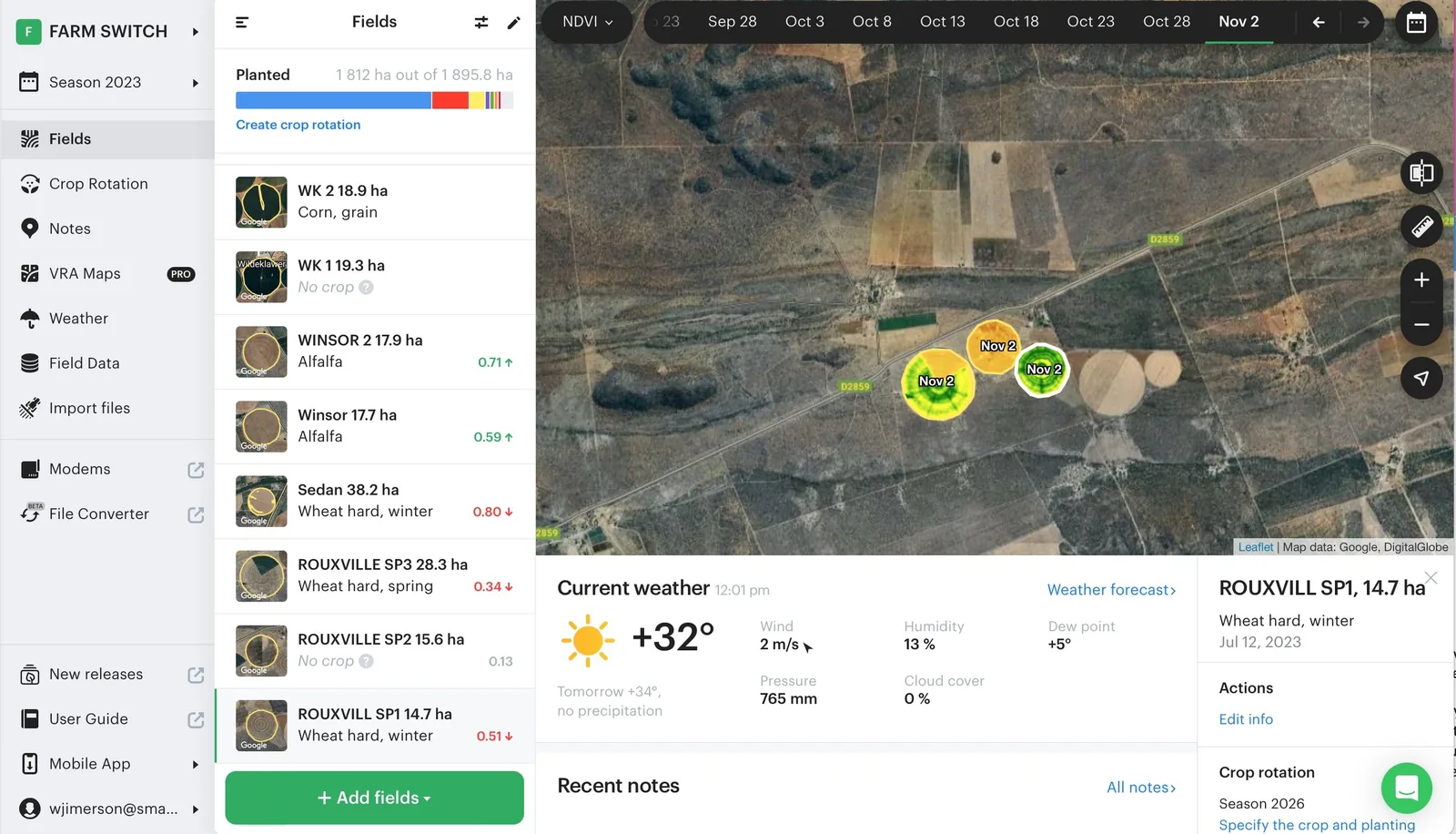
Radar imagery confirms what was actually planted, where and when — through cloud, which matters in a wet season — and reconciles it against the crop plan the facility was granted against. Over-funding and under-planting become visible immediately rather than at year end.
Pre-default detection
Crop stress and deviation from plan surface weeks before they reach the financials. In live operations a 0.06 NDVI decline over seven days triggered a same-day intervention that protected the harvest — and the loan behind it.
Portfolio risk you can act on
A peer-deviation view separates a district-wide drought, which is a provisioning question, from one farm underperforming its neighbours, which is a phone call this week. Exposure visible by crop and by region across the cohort.
How it reaches your people
Three audiences, three channels, one record
- A read-only dashboard for credit and portfolio teams, scoped exclusively to the farms you finance.
- A weekly digest to the relationship manager's inbox — exceptions first, no login required, because a dashboard nobody opens is not a control.
- A weekly digest to the farmer by email or WhatsApp, in plain language. You become a source of useful operational insight rather than only of credit — the strongest retention lever available in a segment where switching is driven by service, not rate.
- Alerting across all three when a farm crosses a threshold, raised immediately rather than at the weekly cycle.
The commercial case
Six things change
| Today | With FarmSwitch |
|---|---|
| Crop failure and declining production surface after the fact | Deterioration surfaces in-season — restructures done from information rather than from crisis |
| Funds released against a borrower-reported crop plan | Planted hectares independently confirmed against the financed plan before further release |
| Relationship managers spend their time gathering and verifying | Verification shifts to the platform; exceptions are surfaced rather than searched for, so the book grows without proportional headcount |
| Renewals argued from reconstructed paperwork | Structured, comparable, independently verified operational fact — faster decisions and more defensible files |
| The bank is a source of credit and little else | The farmer receives something genuinely useful every week, from you |
| Each season's data evaporates | A compounding farm-level record underpinning behavioural scoring and insurance pricing |
Beyond monitoring
When you want to do something about what you can now see
Visibility is the foundation, not the destination. Once verified farm data is flowing, the same spine supports capabilities that change the economics rather than just the reporting — each one separately scoped and taken up only if and when you decide the case is made.
Operate
Borrowers run day-to-day operations on the platform as a condition of facility. Deviation is visible the moment a task is missed — and execution discipline becomes a measurable, priceable variable, which is what opens lending to borrowers who have no audited statements.
Assist
Agronomists and mentor farmers deployed to recover at-risk accounts and expand strong ones. The portfolio becomes actively managed in both directions rather than reported on after the fact.
Supply
Inputs procured through the platform and paid direct to suppliers. The borrower receives inputs, not cash — removing cash-diversion risk and converting input margin that currently leaves the relationship into a shared fee pool.
Services
Vetted mechanisation, spraying, harvest and logistics booked and paid through the platform. Execution certainty behind the exposure, and service spend that currently sits entirely outside the relationship becomes visible transaction flow.
Proof · restructuring a distressed book
R9.9 million of flood losses, and a recovery an Investment Committee accepted
The 2024/25 Western Cape floods caused R9.9 million of losses across eleven enterprises financed through ForFarmers Financial Services, a SEDFA-registered credit intermediary operating under the Jobs Fund WIRP.
FarmSwitch data underpinned a structured recovery across 1,887 economically viable hectares. Eight seasons of vegetation history distinguished viable land from marginal land. Productivity-zone mapping enabled variable-rate input allocation. Drone-led application contributed nitrogen savings on top.
The platform produced an evidence-based five-year recovery pathway that the Jobs Fund Investment Committee accepted — moving the book from a projected R9.58 million deficit in 2026 to a R5.40 million surplus by 2030.
How a pilot works
Small, evidence-based, and genuinely reversible
We would rather prove this on a defined cohort in one region than negotiate a book-wide agreement on a deck. A pilot is deliberately light on your side: a read-only extract for the cohort, a data-sharing agreement, a half-day session for the participating relationship managers, and an executive sponsor to chair the review at the end.
Mobilise
Confirm the cohort and region, execute the data-sharing agreement, hold the kick-off and agree the success measures up front — including a matched control cohort, so the review rests on comparison rather than on a dashboard.
Onboard
Digitise the boundaries, pull the satellite history, build the soil and productivity layers and construct a farm profile per borrower, with a verified planted-hectare baseline.
Activate
Release the dashboard, run the relationship-manager workshop, and switch on alerting plus the weekly digests to both your team and the participating farmers.
Monitor
Continuous monitoring and alerting, a monthly portfolio review with the credit team, and an alert log with intervention tracking so the value is auditable rather than asserted.
Review, and decide
Measured against the criteria agreed at the start and against the control cohort. Scale it, or stop. Because the pilot window closes before harvest, we deliver a season completion report afterwards — harvest verification, yield back-testing and arrears comparison — whichever way the decision goes.
The dashboard is read-only and scoped exclusively to the farms you finance. End-to-end encryption, role-based access control, POPIA-aligned handling and South African data residency apply throughout. We can supply data-sharing and consent templates already in use with comparable lending programmes.
Put it on a cohort and see
Fifty to a hundred borrowers in one region is enough to settle the question either way. Tell us about your book and we will scope it honestly.